


Leading with AI: Strategy and Product Transformation
From AI readiness to real-world product impact
Benefit from 7% off on this integrated learning journey
Leading with AI: Strategy and Product Transformation brings together two complementary Stanford Online courses into one integrated learning experience. This journey combines AI leadership frameworks with human-centered product innovation, enabling professionals to lead AI adoption while designing AI-powered products that deliver real-world value.

Lead with confidence at the intersection of strategy, product innovation, and AI
Leading with AI: Strategy and Product Transformation from Stanford Online helps professionals move beyond AI experimentation toward scalable organizational and product impact. Over 12 weeks, this integrated learning journey combines AI-Driven Leadership: Strategies for the Future and AI-Powered Product Innovation to build the leadership perspective and product design frameworks required in the AI era.
Led by Stanford faculty and designed for professionals leading AI initiatives, this program develops the judgment required to adopt AI strategically by aligning data, workflows, people, and product decisions, enabling leaders to drive responsible AI from organizational strategy through human-centered product solutions.
Industry insights
$407 billion
is the projected global spend on AI systems by 2027, to drive leadership decisions and product innovation.
Source: IDC Worldwide AI Spending Guide
95%
of leaders see AI improving leadership decision-making, highlighting growing reliance on AI.
Source: IBM Survey
70%
of AI initiatives fail to scale due to design and alignment gaps, signaling gaps in leadership and design.
Source: McKinsey
What will you learn?
Apply AI-driven decision-making across real-world organizational and industry contexts.
Align AI initiatives with business objectives to drive efficiency and innovation.
Evaluate algorithmic capabilities across the AI lifecycle.
Assess organizational readiness for AI adoption, including data, governance, and change management.
Guide the development of trustworthy, human-centered AI products while translating AI strategy into scalable workflows.
Who is this program for?

Mid- to senior-level executives including CEOs, CTOs, and senior leaders with decision-making authority who are responsible for guiding AI adoption, organizational strategy, and transformation

Product leaders and product managers building or overseeing AI-powered products and services who want to identify high-value AI opportunities and design products that are trustworthy, usable, and human-centered

Digital transformation, innovation, and strategy leaders driving enterprise-wide digital initiatives who need to align AI capabilities with business objectives, operational priorities, and long-term organizational impact

Technology and data leaders leading data, analytics, or AI teams who seek to improve AI readiness, configure scalable workflows, and integrate generative and predictive AI into organizational processes

Entrepreneurs, founders, and business owners looking to implement AI strategies responsibly within their organizations and translate AI capabilities into sustainable product and business value
Learners typically bring experience in leadership, product development, innovation strategy, or organizational decision-making. No prior technical AI experience is required.
Program outline
1
Course 1: AI-Driven Leadership: Strategies for the Future
Duration: 6 weeks
Module 1: How leaders create conditions for effective integration of predictive analytics
Understand the leadership actions that drive adoption and effective use of predictive analytics tools.
Illustrate leadership activities that foster effective implementation of predictive analytics tools and how they influence team members’ adoption and utilization of these tools.
Assess current frameworks, organizational structures, and evaluation methods for predictive analytics.
Develop a new framework, propose a novel organizational structure for AI implementation, and outline innovative evaluation procedures for AI initiatives.
Module 2: How leaders create conditions for effective integration of generative AI and agentic AI
Learn how leaders guide the successful implementation of generative AI systems across teams and workflows. Learners will also explore the distinction between agentic and non-agentic systems, including their implications for governance, scaling, and organizational design.
Describe differences between predictive analytics and generative AI, including differing risks and opportunities.
Summarize leaders’ activities that foster effective generative AI implementation and how they shape team members’ adoption and use of these tools.
Evaluate existing framing, structuring, and evaluation schemes for generative AI.
Create new framing for a generative AI strategy, draw up a new proposal for AI structuring, and define new AI evaluation processes.
Understand maturity models for generative and agentic AI adoption, from experimentation to enterprise-scale systems.
Module 3: Creating a culture of data excellence
Strong AI systems require strong data foundations.
Evaluate your current organizational data culture, focusing on issues related to data quality, misuse, silos, integration, and governance.
Assess organizational data readiness for generative AI.
Formulate a governance, compliance, and ethical framework for sustaining high-quality, well-governed data.
Module 4: Configuring workflows and decisions for machine learning
Understand how machine learning changes processes, workflows, and decision-making.
Discover the different ways that machine learning workflows are configured.
Predict when a change process or tool is likely to produce resistance or adoption.
Plan or design a machine learning workflow.
Module 5: Configuring workflows for generative AI and agentic AI
Explore how modern AI systems can be embedded into day-to-day operations.
Understand the different ways in which generative AI workflows are configured.
Recognize essential evaluation practices for generative AI workflows.
Plan or design a generative AI workflow.
Module 6: How the work of managers will change in the age of AI
Examine how leadership roles evolve when AI becomes part of management systems.
Examine how managers are using AI to design organizations, focusing on AI’s role in decision-making, structuring information flows, and coordinating resources.
Describe the risks and opportunities associated with algorithmic management.
Conceptualize a tool to aid in an organizational or managerial function.
Live webinars with the faculty
Participate in two interactive, faculty-led live webinars designed to deepen your understanding, address your questions, and connect course concepts to real-world leadership scenarios.
Capstone project 1: Planning AI implementation for organizational impact
In the capstone project, you will apply the core frameworks to plan the implementation of an AI capability within an organization. You will identify and prioritize high-impact use cases, assess organizational readiness, and evaluate the potential impact on workflows, teams, and business performance. Using the leadership strategies explored throughout the course, you will examine likely barriers to adoption, define approaches for change management and reskilling, and outline the governance conditions required for successful execution. Through this capstone, you will strengthen your ability to lead AI transformation initiatives while applying practical frameworks to real-world organizational challenges.
2
Live webinar: Connecting strategy to product
Duration: 60 Minutes (live session)
This session connects the strategic mindset developed in Course 1 with the innovation focus of Course 2. It is designed to help participants transition from the leadership perspective introduced in the first course to the applied innovation lens of the second, highlighting how the two parts of the program fit together as a cohesive learning journey.
3
Course 2: AI-Powered Product Innovation
Duration: 6 weeks
Module 0: AI fundamentals for product decision-makers
Build a clear, practical understanding of what modern AI can and cannot do. This module cuts through hype to help you assess capabilities, limitations, and real-world applications with confidence.
Topics include:
The foundations of AI in machine learning
How large language models (LLMs) are developed and function through tokenization
Training and deploying LLMs
Real-world applications across products and industries
Module 1: Finding your AI edge: What AI will (and won’t) do for your product and strategy
Apply your understanding of AI to real product and strategic decisions. Learn how to evaluate where AI can be used reliably, where it introduces risk, and how to make informed choices about its role in your product. This module introduces the sharp-edged vs. rough-edged framework to help leaders assess error tolerance, trust dynamics, and investment readiness. You will also explore how to reframe high-stakes problems into safer, more adaptable workflows and forecast how AI capabilities may evolve over time.
Topics include:
Understanding the challenge of predicting AI progress
Defining sharp-edged and rough-edged problems
Understanding why AI performs differently on each type
Using the framework to predict what comes next
Turning sharp problems into rough ones
Module 2: Replacing vs. augmenting people with AI
Examine why many AI products succeed or fail based on how well they augment human capability. This module introduces intelligence augmentation as a guiding principle using real-world examples to understand where AI enhances capabilities, and where it undermines trust, usability, or decision-making.
Topics include:
People: where AI lives or dies
Intelligence augmentation
Achieving intelligence augmentation
Module 3: Creating differentiated AI products
Analyze why users default to general-purpose AI tools even when specialized products exist. Learn how habit, friction, and channel factors shape adoption, and identify what drives users to switch or stay. Develop strategies to shape AI products that deliver differentiated value and are consistently chosen in real-world use.
Topics include:
Why so many AI products fail
Lessons from past technologies
The ChatGPT gravity well
The psychology behind the pull
How to escape the gravity well
Designing AI products users will adopt
Module 4: Responsible and ethical AI product development
Explore how ethical and societal considerations influence the success and integrity of AI products. This module introduces structured techniques, such as ethics and societal review processes, to identify risks early, articulate mitigation principles, and embed responsible design decisions into product development.
Topics include:
Why do AI products need to be concerned with ethical issues? (Why not “I’m just an engineer?”)
Two techniques for identifying ethical issues: Tarot Cards of Tech and Black Mirror Writers room
Ethics and societal review as a structured process for early-stage projects
Module 5: Chatbot interaction: How to get it right, and what goes wrong
Investigate people's psychological responses to AI systems as social actors. Learn key principles behind chatbot design, including the Media Equation, Uncanny Valley, and Replicant Effect, and examine how design choices influence trust, transparency, and user perception.
Topics include:
The AI chatbot rogues' gallery
How AIs integrate as social actors
How AI influences our social interactions with each other
Module 6: AI agent simulation of your users and customers
Learn how generative agents can simulate user and customer behavior to inform product decisions. This module explores how these agents are built, where they are most useful, and how to assess their limitations and risks when used for design exploration and decision-making.
Topics include:
Motivations for human behavior simulations
Generative agents
High-level architecture for generative agents
Agent believability and long-term behavior
Applications for generative agents
Live webinars with the faculty: Participate in two interactive, faculty-led live webinars designed to enhance your understanding, address real-world challenges, and connect leadership concepts to practical AI implementation.
Capstone project 2: Evaluating AI opportunities from concept to validation
Participants apply core frameworks to evaluate an AI opportunity from concept through validation, assessing feasibility, value, and associated risks. Using generative AI simulations, they test user responses and refine their approach based on these insights.
4
Integrated reflection activity
This final reflection activity challenges participants to integrate their experience implementing generative AI in high-value workflows with their experience developing and evaluating an AI-powered product concept. Drawing on frameworks from both courses, learners will examine how leaders navigate implementation decisions, product idea generation, ethical review, and simulation-based feedback, articulating key insights and leadership implications across both contexts.
Program walkthrough

Complete two complementary Stanford Online courses over 12 weeks.

Participate in five live sessions with Stanford faculty on AI strategy and product design.

Apply concepts through hands-on assignments and guided peer discussions.

Work with modern large language models to explore generative agents, workflows, and AI-powered decision-making.

Earn three Stanford Online credentials, with Continuing Education Units upon completion.
Instructors

Melissa Valentine
Associate Professor of Management Science and Engineering, Stanford University
Melissa Valentine is an Associate Professor at Stanford University in the Department of Management Science and Engineering and a Senior Fellow at the Stanford Institute for Hu...

Michael Bernstein
Professor of Computer Science, Stanford University
Michael Bernstein is a Professor of Computer Science at Stanford University, where he is a Bass University Fellow and Senior Fellow at the Stanford Institute for Human-Centere...
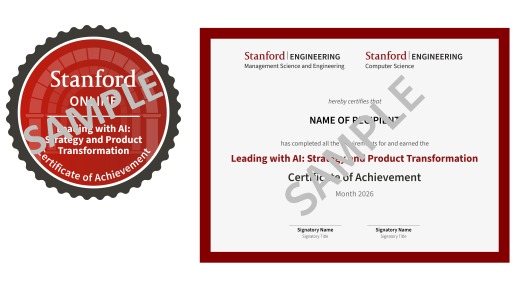
Certificate of Achievement
All learners who successfully complete this integrated learning journey will earn three Stanford Online credentials: two digital badges awarded for completing AI-Driven Leadership: Strategies for the Future and AI-Powered Product Innovation, and one digital Certificate of Achievement awarded for completing Leading with AI: Strategy and Product Transformation.
These credentials are verified on the blockchain and allow you to share your accomplishments with your network, verify your credentials to employers, and communicate the scope of your acquired expertise.
8.5 CEU-equivalent.
*To obtain CEUs, complete the accreditation confirmation, which is available at the end of the course. CEUs are calculated for each course based on the number of learning hours. Note: All certificate images are for illustrative purposes only and may be subject to change at the discretion of Stanford Online.
Frequently asked questions
1
What advantages does the online learning experience offer?
This integrated learning journey is delivered fully online and combines faculty-led instruction, structured discussion forums, and applied assignments across both courses. The format allows learners to engage with Stanford faculty and course content while applying concepts to real-world leadership and product challenges.
2
How is the program structured?
The program consists of two six-week courses. Learners begin with AI-Driven Leadership: Strategies for the Future, followed by AI-Powered Product Innovation. Across both courses, learning includes faculty-led instruction, structured discussion forums, and applied projects.
3
Who is this program designed for?
This program is designed for professionals responsible for leading, shaping, or supporting AI initiatives across organizations and products. Typical participants include executives, product leaders, innovation and strategy professionals, technology and data leaders, and entrepreneurs working with AI-enabled offerings.
4
Is prior technical or AI experience required?
No prior technical AI experience is required. Learners typically bring experience in leadership, product development, innovation strategy, or organizational decision-making.
5
What credentials will I earn upon completion?
Learners who successfully complete the program will earn three Stanford Online credentials: two digital badges for completing the individual courses and one digital certificate for completing the integrated learning journey. Eligible learners may also earn Continuing Education Units (CEUs) upon completing the required accreditation confirmation.
6
Are any taxes applicable to this course?
Applicable taxes will be calculated and added at checkout in accordance with country/state regulations.
Connect with a Program Advisor for a 1:1 session
Didn't find what you were looking for? Schedule a call with one of our Global Alumni Program Advisors or call us at +1 315 871 5140
Register now and boost your professional trajectory.
Starts on