


ONLINE COURSE
UI/UX Design for AI Products
Please note that our team is away from December 22, 2026 to January 5, 2027 for the year-end holidays. We look forward to addressing your queries when we resume operations in the new year.
Strategic design in the digital era
In the rapidly evolving UI/UX design field, creating positive user experiences powered by artificial intelligence (AI) is increasingly crucial. In the years ahead, designers and product teams will need to leverage AI to automate repetitive tasks and refine design patterns, processes, and techniques. To meet this growing demand, Stanford Online has developed a job-relevant curriculum to guide you through your AI-powered design journey.
How your AI product design journey unfolds
AI UX design skills you will gain

Design more effective AI-powered interfaces
Create AI-enabled product experiences where AI is integrated into workflows in ways that are useful, clear, and actionable for users.
Move beyond one-size-fits-all chatbot experiences
Recognize the limitations of prompt-based interactions and design more specific, task-focused AI experiences.
Prototype AI-powered experiences before building
Use LLM-based and Wizard of Oz prototyping methods to test AI interactions, user expectations and product concepts.
Make better automation decisions
Balance AI automation with user control by applying human-AI interaction design principles that support usability and reduce errors.
Design for calibrated trust in AI systems
Identify challenges such as overreliance and undertrust, and create experiences that help users engage with AI appropriately.
Apply AI tools with design judgment
Evaluate AI-augmented design tools and understand how they can support, rather than replace, human-centered design practices.
Who will benefit from this course

Professionals in user interface (UI) and user experience (UX) design who want to integrate artificial intelligence into their designs and understand its impact on user experience

AI developers and engineers involved in developing AI systems who want to enhance their understanding of user experiences and improve the usability of AI applications

Product managers who wish to understand the fundamentals of designing AI-driven user experiences to create more user-friendly products

Professionals and students with experience in designing user-facing products
Course outline
1
Quick primer of how generative AI works
Review the core principles behind modern AI and generative models
Interpret how Large Language Models (LLMs) like ChatGPT represent information, reason, and generate outputs
Evaluate real-world implementations of generative AI across product and design workflows
2
The Spork problem: The dangers of prompt-based interfaces
Identify why users struggle with prompts
Evaluate the design limitations of one-size-fits-all chat interfaces using the Spork Problem as a diagnostic framework
Analyze how products like Adobe, Grammarly, and VS Code use embedded AI interactions to overcome these limitations
Design a task-specific, AI-augmented interface, mapping user needs to interaction flows, wireframes, and model requirements
3
Prototyping AI designs
Understand the benefits of prototyping and why it is useful in AI-Powered design
Learn to apply large language model prototyping to test the feasibility and desirability of an AI design
Implement “Wizard of Oz” prototyping to develop an initial mockup of an
AI-based design, while omitting the actual AI components
4
AI-augmented design tools
Articulate the capabilities of AI-augmented design tools and their role in modern UI/UX workflows
Assess the limitations and challenges of AI design tools, including areas where human judgment remains essential
Develop strategies to integrate AI-augmented tools effectively into your design workflows
Apply AI-powered design tools to create a nontrivial design, reflecting on effectiveness, constraints, and learnings
5
User control vs. AI automation
Analyze the core tension between full user control and tools that enhance automation, including associated risks of error
Describe design patterns used to manage the trade-off between user control and automation
Examine case studies like Clippy, Google Maps, Google Docs, and Gmail to assess what enables or undermines the user control–automation balance
6
User trust and explainability in AI systems
Learn about user trust in AI systems and why it influences adoption and effective use of AI-powered tools
Explore human-AI complementarity and how Generative AI models are currently utilized to achieve it
Understand the algorithm aversion and overreliance paradox, and strategies to mitigate it using explainability techniques
Capstone project
The capstone project gives you the opportunity to apply your AI and UX skills by designing a real-world AI-powered product. You will identify a problem through user research, determine the right balance between automation and user control, and evaluate ethical considerations to ensure responsible design. This hands-on project helps you translate course insights into an AI solution grounded in your industry context and strengthens both your portfolio and your practical capability.
Case studies
Explore real-world AI product decisions and examine how leading products approach human-AI interaction, automation, usability and user trust.
Disclaimer: All product and tool names are trademarks or registered trademarks of their respective owners. Their inclusion does not imply affiliation with or endorsement by the respective trademark owners. The list of products and tools is illustrative only and is not exhaustive.
Featured program elements

ChatGPT and other LLMs
Leverage ChatGPT to automate tasks, create user-friendly experiences, and drive customer engagement.

The psychology of AI
Explore AI from a psychological perspective by studying topics such as user trust, overreliance, the Media Equation, and the Replicant Effect.

Case studies in applied AI design
Examine real-world products such as Google Maps, Google Docs, and Adobe to understand how AI is integrated into design, and how it impacts user control, trust, and usability.
Instructor

Michael Bernstein
Professor of Computer Science, Stanford University
Michael Bernstein is a Professor of Computer Science at Stanford University, where he is a Bass University Fellow and Senior Fellow at the Stanford Institute for Human-Centere...
Course walkthrough

Live sessions with Stanford faculty

Learn with an AI Tutor for a seamless experience

Hands-on assignments to design, prototype, and evaluate AI-powered user experiences

Real-world case studies and industry examples

Practical frameworks and tools for designing intuitive, human-centered AI interaction

Certificate of Achievement from Stanford Online
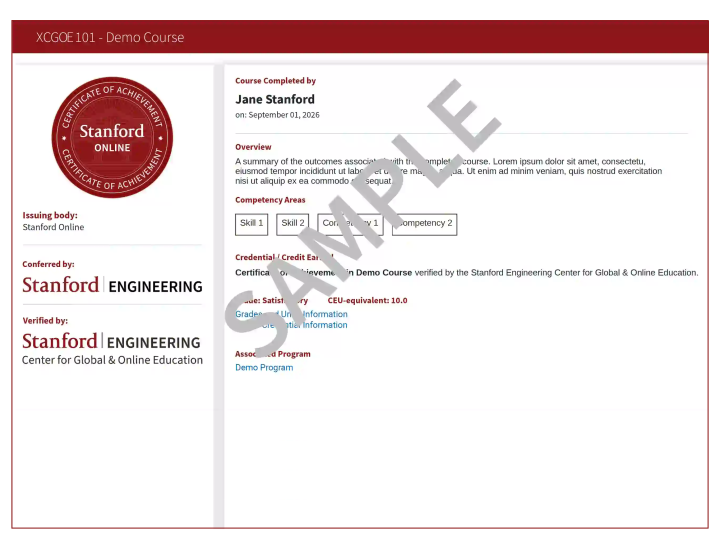
Certificate of Achievement from Stanford Online
All learners who successfully complete the course will be awarded a Stanford Online Certificate of Achievement, recognizing proficiency in the course material.
The Certificate of Achievement for an individual course will be issued in a digital badge format, verified on the blockchain. The digital badge format allows you to share your accomplishments with your network, verify your credentials to employers, and communicate the scope of your acquired expertise.
4 CEU-equivalent.
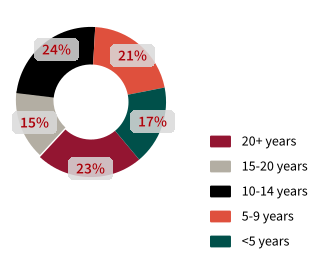
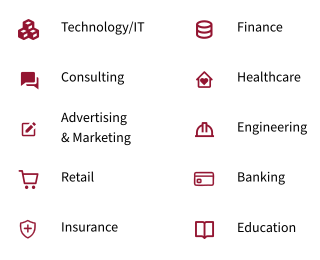
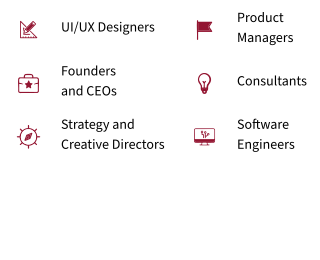
Past participant profiles
Work experience
Top industries
Top profiles
* Familiarity with the human-centered design process is helpful.
Learners feedback
“This course helped me step back and learn how to design better AI products from a human-computer interaction perspective. I learned how to keep human needs and HCI best practices at the center of the process, which was especially valuable as I have been working in this area for years.
The course material, modules, and examples were very valuable to my learning experience, and the assignments helped me apply what I learned in practice. I also appreciated the discussion forum, where posts and responses from peers with diverse backgrounds gave me new perspectives.
The capstone project helped me put all these learnings into practice, from research and design concepts to ethical review. The live sessions with Ayo and Professor Michael Bernstein also offered valuable insights. I really enjoyed this process and would definitely recommend this course.”...
Maria Joseph Daniel Victor
Principal UX Designer,
Amazon
“This course was my first exposure to AI as a subject, and it made me curious to learn more. I found the whole course valuable, especially the use of AI agents and how to apply guardrails to protect users and society.
The program also helped me think about how AI can improve technology companies and project management. Overall, I found the experience excellent, with excellent assignments, faculty live sessions, and office hours.”...
Luis Garza
Project Manager,
Apple
“The breadth of content in each module was great. I felt like I really learned something new, and I loved the mix of academic research and real-world examples I can use in my job. The content stayed interesting throughout, and the assignments and discussion posts were useful and thought-provoking.
The capstone project was especially valuable because it took me through the full arc, from user research to prototype to trust-calibrated variants, which helped make the theory concrete. Before this course, I thought of AI design mostly in terms of making AI helpful. The course reframed that for me: the goal is not just building user trust, but calibrating that trust to match the AI’s actual reliability.
Designing for calibrated trust has become a lens I now apply to every AI feature I evaluate at work. Overall, I feel more confident using AI thoughtfully in my design process.”...
Teressa Clark
UX Manager,
Colgate-Palmolive
Frequently asked questions
1
What advantages does our online learning experience offer?
Studying online with us extends past a strictly digital learning experience. With Stanford Online, you’ll have the chance to:
Attend international workshops and live webinars.
Collaborate and engage with Stanford professors, instructors, and contributors.
Meet and network with other program participants from all over the globe.
2
Will I work on a real-world project during the program?
Yes. The course includes a hands-on capstone project where you design a real-world AI-powered product. You will identify a user problem, evaluate when AI is the right solution, design interactions beyond simple prompts, and address trust and adoption risks. The project helps you apply frameworks to build a practical, user-centered solution.
3
How much time should I expect to dedicate to the course each week?
The course is designed to fit into a professional schedule, requiring approximately 4–6 hours per week. Over six weeks, you will participate in live faculty sessions, complete assignments, and apply concepts through case studies and project work.
4
Do I need prior AI or programming experience to join this course?
No. This course is not about coding or building AI models. It is designed for professionals who want to understand how to drive strategy for AI-powered products, focusing on user experience, interaction design, and decision-making around trust, usability, and adoption.
5
What certificate will I receive after completing the course?
Upon successful completion, you will receive a Stanford Online Certificate of Achievement, issued as a digital badge verified on the blockchain. You will also earn 4 Continuing Education Units (CEUs) that reflect the learning hours completed in the program.
6
How can I know if this program is for me?
Schedule a call with one of our Global Alumni program advisors to address any doubts or questions you might have about this course.
7
Are any taxes applicable to this course?
Applicable taxes will be calculated and added at checkout in accordance with country/state regulations.
Connect with a Program Advisor for a 1:1 session
Didn't find what you were looking for? Schedule a call with one of our Global Alumni Program Advisors or call us at +1 315 871 5140
Explore complementary learning experiences
AI-Driven Leadership and Product Design
Build capabilities across AI leadership and AI product design
Benefit from 15% savings on this multi-course series
Artificial intelligence is transforming how organizations make decisions and how products are designed and experienced. Effective leaders need the ability to guide AI adoption while understanding how AI systems shape user experiences and trust.
This multi-course series brings together AI-Driven Leadership: Strategies for the Future and UI/UX Design for AI Products, enabling learners to explore both strategic decision-making and AI product design principles.
This multi-course series brings together AI-Driven Leadership: Strategies for the Future and UI/UX Design for AI Products, enabling learners to explore both strategic decision-making and AI product design principles.
Register now and boost your professional trajectory.
Starts on