

ONLINE COURSE
AI Solutions & Applications: Design, Automate, and Deploy with No-Code AI
Build AI applications with no-code and low-code tools
AI-assisted development and no-code and low-code tools are expanding who can create functional applications and how ideas move from business need to working prototype. Professionals with firsthand knowledge of business problems can now take a more active role in planning, designing, testing, and refining AI-enabled solutions.
Effective AI applications still depend on structured data, sound application logic, reliable workflows, thoughtful integration, and responsible implementation. This practical no-code AI course from Stanford Online brings these elements together in a curriculum focused on developing AI-powered applications for real business needs. You will work across data design, application architecture, AI features, workflow automation, integration, testing, and deployment preparation.
How your learning journey unfolds
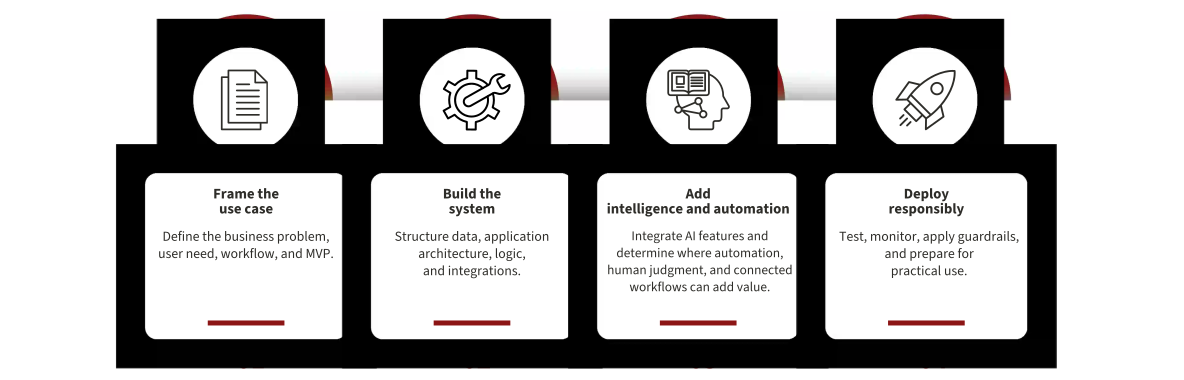
During this course, build the capabilities to
Identify high-impact AI opportunities: Evaluate potential business value and make informed build-vs-buy decisions.
Translate business needs into scalable AI applications: Design end-to-end no-code workflows and prepare them for responsible testing and limited rollout.
Choose the right AI approach: Match rules, pre-built machine learning, or generative AI to the available data and intended outcome.
Design AI-enabled workflows: Connect application logic, triggers, AI features, and automation while determining where human judgment should remain.
Develop reliable, safe, and compliant AI: Use evaluation, guardrails, and monitoring to support reliability, safety, and compliance in AI-enabled systems.
Build AI applications for real business problems
By the end of the course, you will be able to:
Frame and scope an AI-enabled solution: Identify where AI adds value, map the user journey, and define an MVP.
Build and refine a functional prototype: Combine data, logic, workflows, and AI features, then test and improve the solution.
Connect data, tools, and systems: Integrate hosted data, APIs, connectors, and trigger-action workflows.
Test and prepare for deployment: Evaluate application behavior, troubleshoot workflows, monitor performance, and prepare for practical use.
Strengthen reliability and responsible use: Apply guardrails, privacy, security, monitoring, and human oversight to support responsible use.
Who is this online course for?

Business and functional team leads identifying high-value AI opportunities and shaping practical solutions

Product managers and digital or innovation leaders translating business and user needs into AI-enabled applications, workflows, and MVPs

Operations, program, and project managers seeking to automate processes, connect systems, and improve ways of working

Consultants and business analysts turning business requirements into structured prototypes and implementation plans

Entrepreneurs and founders testing AI-enabled applications or MVPs before committing to more extensive development
*No prior programming experience or experience with any specific tool is required. Module 0 provides setup guidance for the core course tools. Information about required accounts, subscriptions, and any course-provided access will be shared before the course begins.
Course outline
Module 0: Course orientation and tool setup
Prepare the core tool stack and understand the hands-on journey from setup through deployment.
Set up and connect Claude Cowork, Supabase, GitHub, and Vercel.
Identify the purpose of each tool within the course workflow.
Prepare a working environment for building AI-enabled applications.
Understand how AI-assisted application building differs from traditional coding.
Module 1: AI-powered no-code/low-code applications
Use Claude Cowork to plan, build, test, refine, and deploy a functional no-code web application.
Understand how Claude Cowork differs from chat-based AI for application building.
Apply plan-first prompting to gather requirements, generate a solution, and refine its output.
Build and test a no-code web application through guided and individual assignments.
Publish through GitHub and Vercel, test the deployed application, and assess when professional engineering support is needed.
Module 2: Data design for AI systems
Build a structured data foundation in Supabase and examine how data quality and access decisions affect AI outputs.
Create related Supabase tables using appropriate fields, keys, and sample data.
Clean and import a synthetic dataset, then compare AI outputs before and after cleaning.
Identify sensitive data and apply data-minimization, access-control, and credential-safety principles.
Use the Include–Exclude–Justify process to connect appropriately limited data to an AI-enabled application.
Module 3: AI application architecture and logic design
Understand how an application’s interface, logic, and data layers work together to support reliable workflows.
Map an existing application’s frontend, logic, and data layers.
Design a record lifecycle using states, transitions, events, triggers, and business rules.
Build, acceptance-test, and troubleshoot a stateful workflow.
Configure a secure event-based email notification using Resend and server-side credential storage in Supabase.
Module 4: AI feature engineering with no-code
Choose, build, test, and strengthen an AI feature for a defined business need.
Determine when to use rules, pre-built machine learning, or generative AI.
Define and connect a prompt-based AI feature within an application.
Test normal, edge, and problematic inputs and document how the feature responds.
Add a purposeful guardrail and determine where human review should remain in the workflow.
Module 5: Designing and building AI applications
Turn a real business problem into a focused, user-tested AI-enabled prototype.
Frame the problem and identify an appropriate AI use case within the workflow.
Map the user journey and define the MVP scope for an initial version.
Build a functional prototype with at least one working AI feature.
Test the prototype with a real user and make an evidence-based improvement.
Module 6: Workflow automation, integration, and deployment
Evaluate where automation adds value, then extend an application with appropriate automation and integrations and prepare it for practical use.
Evaluate business workflows to determine where to automate, augment with AI, or keep human judgment in the loop.
Design appropriate trigger-action workflows and connect tools or systems.
Monitor automated workflows to identify and respond to failures.
Make responsible rollout decisions and prepare an application for practical use.
Module 7: Building reliable and responsible AI systems
Prepare AI-enabled applications for safer, more reliable use while understanding when additional technical support is required.
Evaluate AI outputs for reliability, consistency, usefulness, and known limitations.
Apply guardrails, fallback strategies, human review, privacy, security, and access controls.
Monitor workflows and assess when an application is appropriate for testing, limited rollout, or internal use.
Explore agentic concepts and recognize when advanced systems require technical-team involvement.
Build practical AI applications through hands-on work
Develop an AI-enabled application progressively through guided activities spanning data, logic, AI features, automation, integration, and deployment.
AI-assisted no-code building and evidence-based refinement
Structured data, application logic, and stateful workflows
Prompt-based AI features, testing, guardrails, and human oversight
Workflow automation, system integrations, and deployment preparation
Capstone project: Build an AI-enabled application with no-code tools
The course culminates in a capstone project in which you will complete an AI-enabled application or prototype that addresses a defined problem.
You will bring together problem framing, MVP definition, structured data, application logic, AI features, workflows, automation, and deployment preparation. You will also apply responsible AI practices by reviewing outputs and considering privacy, security, reliability, and the limitations of your prototype.
By the end of the project, you will have demonstrated the practical use of no-code tools and reflected on your design decisions, limitations, potential improvements, deployment considerations, and next steps.
Tools you will work with

Disclaimer: All product and tool names are trademarks or registered trademarks of their respective owners. Their inclusion does not imply affiliation with or endorsement by the respective trademark owners. The list of products and tools is illustrative only and is not exhaustive.
Frameworks you will use
You will work with:
Plan-first prompting and build-vs-buy frameworks to define requirements and choose a development path
Structured data design and the Include-Exclude-Justify process to organize data and control AI access
Application architecture and logic to design workflows, rules, events, and triggers
Rules, pre-built machine learning, and generative AI for different business needs
AI feature testing, guardrails, and human oversight to support responsible use
Workflow automation and integrations to connect tools and systems
Course walkthrough

Learn from Stanford faculty
Engage with course content created by Stanford faculty whose teaching informs the practical design, development, and responsible implementation of AI-enabled applications.

Flexible online learning
Progress through structured online modules, supported by a facilitator-led live session each week.

Build through hands-on assignments
Move from a guided application build to structured data, application logic, AI features, automation, and a capstone.

Participate in guided discussions
Compare results, examine design decisions, and improve your work through peer feedback.

Work with a connected tool stack
Use connected tools across application building, data management, publishing, and deployment.

Earn a Stanford Online Certificate of Achievement
Receive a credential that recognizes your ability to design, develop, and refine practical AI-enabled applications using no-code and low-code tools.
Featured course elements

Plan-first AI-assisted building
Use Claude Cowork to define requirements, generate an initial application, test its behavior, and make focused improvements.

Connected data, logic, and workflows
Bring together Supabase data, application architecture, business rules, triggers, integrations, and AI features as your application evolves.

Testing, guardrails, and responsible use
Test edge and problematic inputs, protect sensitive data, apply guardrails, and determine where human oversight should remain.
Industry insights
US$12.5B
78%
US $75B+
Instructor

Christopher Gregg
Associate Professor (Teaching) of Computer Science, Stanford University
Chris Gregg is an Associate Professor (Teaching) of Computer Science and the Associate Chair for Education in the Computer Science Department at Stanford University. With over...
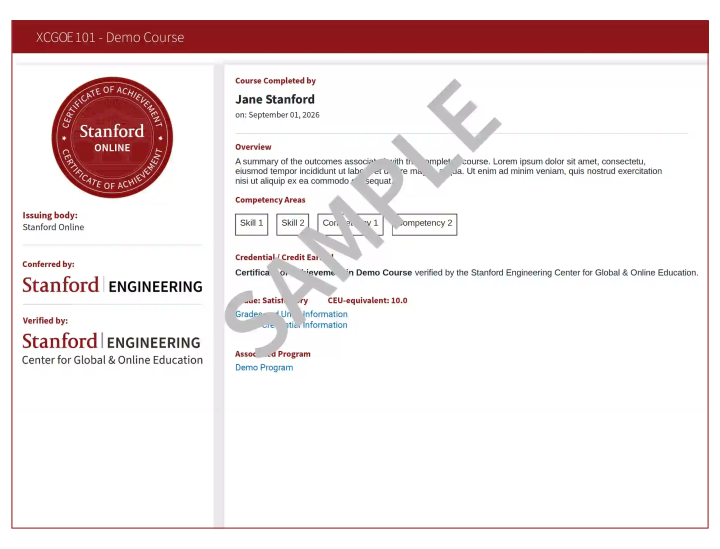
Certificate of Achievement from Stanford Online
All learners who successfully complete the course will be awarded a Stanford Online Certificate of Achievement, recognizing proficiency in the course material.
The Certificate of Achievement for an individual course will be issued in a digital badge format, verified on the blockchain. The digital badge format allows you to share your accomplishments with your network, verify your credentials to employers, and communicate the scope of your acquired expertise.
4 CEU-equivalent.
*Note: All certificate images are for illustrative purposes only and may be subject to change at the discretion of Stanford Online.
Frequently asked questions
What advantages does Stanford Online's learning experience offer?
The course combines Stanford faculty-created content with guided application building, hands-on assignments, discussion forums, and repeated opportunities to test and improve your work. You will also participate in two faculty-led live sessions, while the course facilitator provides a live session each week.
Will I receive a Certificate of Achievement?
Yes. All learners who successfully complete No-Code AI: Building AI-Powered Applications will receive a Stanford Online Certificate of Achievement delivered in a digital badge format and verified on the blockchain. The credential recognizes proficiency in the course material.
Are there any prerequisites for this course?
No prior programming experience or experience with any specific tool is required. Module 0 provides setup guidance for the core course tools.
Will I need to write code?
The course uses AI-assisted and no-code/low-code workflows so you can focus on requirements, application behavior, testing, and refinement rather than traditional code-first development.
Who is this course designed for?
This course is designed for business, product, innovation, operations, program, project, consulting, and entrepreneurial professionals who want to move from using AI tools to developing practical applications, workflows, and prototypes.
Does the course cover agentic AI?
The course introduces agentic workflows in a no-code context and covers when to automate, augment with AI, or keep a person in the loop. It does not focus on building advanced agents. You will learn how to recognize when a project needs that level of technical support.
Will I need to purchase subscriptions for the course tools?
The course uses Claude Cowork, Supabase, GitHub, and Vercel, along with selected supporting services. Before the course begins, you will receive information about required accounts, any subscription requirements, and any paid access provided as part of the course. Module 0 includes step-by-step setup guidance.
Are any taxes applicable to this course?
Applicable taxes will be calculated and added at checkout in accordance with country and state regulations.
Connect with a Program Advisor for a 1:1 Session
Didn't find what you were looking for? Schedule a call with one of our Global Alumni Program Advisors or call us at +1 315 871 5140.
Please note that our team is away from December 21, 2026 to January 5, 2027 for the year-end holidays. We look forward to addressing your queries when we resume operations in the new year.
Register now and boost your professional trajectory.
Starts on