

ONLINE COURSE
AI-Powered Product Innovation
Make better product decisions about AI
As AI capabilities accelerate, organizations must decide where it creates real value, where it introduces risk, and how to integrate it into products that are reliable, trustworthy, and aligned with human decision-making. AI-Powered Product Innovation, a six-week online course from Stanford Online, equips professionals with practical frameworks to evaluate AI opportunities, assess readiness, and guide product decisions in uncertain business environments. Through applied assignments, discussion forums, hands-on work with modern large language models, and faculty-led insights, you’ll move from reacting to AI trends to making confident, future-ready product decisions.
Key takeaways

Identify where AI is appropriate to apply and distinguish viable use cases from high-risk applications.

Evaluate how AI can augment human capabilities and support better decision-making.

Understand the psychological principles behind trust, adoption, and human–AI interaction and how they influence AI-enabled product decisions.

Address ethical and societal risks early through structured approaches to decision-making.

Use generative agents and modern AI systems to simulate user behavior and guide product strategy.

Identify what drives AI product adoption and long-term user behavior in a hands-on capstone project.
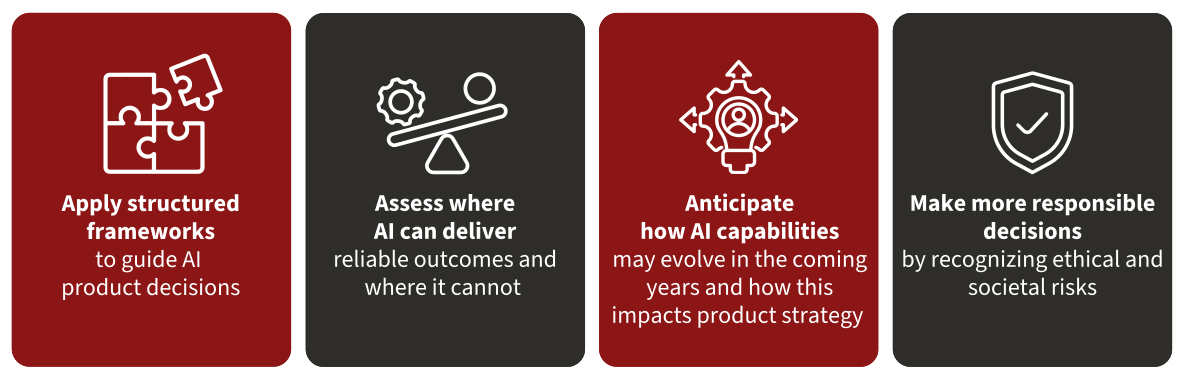
By the end of this course, you will be able to
Who will benefit from this course?

Product leaders and product managers
Individuals responsible for identifying opportunities, defining product direction, and allocating resources in AI-driven initiatives

Innovation executives and strategy teams
Leaders guiding organizational transformation and investing in new technological capabilities

Entrepreneurs and founders
Individuals developing new AI-native offerings who need frameworks for judging opportunity viability

Designers and UX professionals
Those moving beyond interface considerations to broader questions of problem framing, value creation, and human augmentation

AI-adjacent professionals
Those who work with AI-powered systems—such as data scientists, solution architects, and technical program managers—who want a deeper understanding of where AI truly adds value
Course outline
Build a clear, practical understanding of what modern AI can and cannot do. This module cuts through hype to help you assess capabilities, limitations, and real-world applications with confidence.
Topics include:
Review the core principles behind modern AI and generative models
Interpret how large language models (LLMs) like ChatGPT represent information, reason, and generate outputs
Evaluate real-world implementations of generative AI across product and design workflows
Apply your understanding of AI to real product and strategic decisions. Learn how to evaluate where AI can be used reliably, where it introduces risk, and how to make informed choices about its role in your product. This module introduces the sharp-edged vs. rough-edged framework to help leaders assess error tolerance, trust dynamics, and investment readiness. Learners explore how to reframe high-stakes problems into safer, more adaptable workflows and forecast how AI capabilities may evolve over time.
Topics include:
Understanding the challenge of predicting AI progress
Defining sharp-edged and rough-edged problems
Understanding why AI performs differently on each type
Using the framework to predict what comes next
Turning sharp problems into rough ones
Examine why many AI products succeed or fail based on how well they augment human capability. This module introduces intelligence augmentation as a guiding principle using real-world examples to understand where AI enhances capabilities, and where it undermines trust, usability, or decision-making.
Topics include:
People: Where AI lives or dies
Intelligence augmentation
Achieving intelligence augmentation
Analyze why users default to general-purpose AI tools even when specialized products exist. Learn how habit, friction, and channel factors shape adoption, and identify what drives users to switch or stay. Develop strategies to shape AI products that deliver differentiated value and are consistently chosen in real-world use.
Topics include:
Why so many AI products fail
Lessons from past technologies
The ChatGPT gravity well
The psychology behind the pull
How to escape the gravity well
Designing AI products users will adopt
Explore how ethical and societal considerations influence the success and integrity of AI products. This module introduces structured techniques, such as Ethics and Societal Review processes, to identify risks early, articulate mitigation principles, and embed responsible design decisions into product development.
Topics include:
Why do AI products need to be concerned with ethical issues? (Why not “I’m just an engineer?”)
Two techniques for identifying ethical issues: Tarot Cards of Tech and Black Mirror Writers Room
Ethics and societal review as a structured process for early-stage projects
Investigate people‘s psychological responses to AI systems as social actors. Learn key principles behind chatbot design, including the Media Equation, Uncanny Valley, and Replicant Effect, and examine how design choices influence trust, transparency, and user perception.
Topics include:
The AI chatbot rogues' gallery
How AIs integrate as social actors
How AI influences our social interactions with each other
Learn how generative agents can simulate user and customer behavior to inform product decisions. This module explores how these agents are built, where they are most useful, and how to assess their limitations and risks when used for design exploration and decision-making.
Topics include:
Motivations for human behavior simulations
Generative agents
High-level architecture for generative agents
Agent believability and long-term behavior
Applications for generative agents
A hands-on, applied learning experience
Through hands-on assignments, discussion forums, and work with modern large language models, the course provides a practical, applied learning experience focused on real-world product decisions. You will evaluate AI opportunities, analyze problem types using the sharp-edged vs. rough-edged framework, and examine how AI systems influence human behavior and decision-making in product contexts.
Throughout the course, you will apply structured frameworks to assess where AI can deliver reliable value, where it introduces risk, and how it shapes product outcomes. You will also use generative AI systems to simulate user behavior, helping you explore how different approaches impact trust, adoption, and long-term effectiveness.
As the course progresses, these applied exercises build your ability to make informed, responsible product decisions in environments where AI capabilities and user expectations are constantly evolving.
Capstone project
In the capstone project, you will apply the course’s core frameworks to evaluate an AI opportunity from concept through validation. You will identify and prioritize intelligence-augmenting product ideas, assess their feasibility and potential value, and examine associated risks, including ethical and societal considerations.
Using generative AI simulations, you will test how different users respond to your concept and refine your approach based on those insights, grounding your evaluation in realistic product scenarios and user behavior.
By the end of the course, you will have strengthened your ability to evaluate AI opportunities and make informed product decisions, while critically assessing the strengths and limitations of AI in real-world applications.
Frameworks and methods you will use
This course equips you with practical frameworks and approaches to evaluate, apply, and manage AI in real-world contexts.
You will work with:
Frameworks to assess what AI can and cannot do reliably
Methods to identify high-value use cases and avoid low-impact investments
Approaches to evaluate user behavior, trust, and product adoption
Decision frameworks for applying AI to augment human capabilities
Techniques for simulating user behavior using modern AI systems
Structured approaches to identify and manage ethical and societal risks
Industry insights
70%
85%
$407billion
Course walkthrough

Learn directly from Stanford faculty through instructor-led guidance.

Learn with an AI Tutor for a seamless experience.

Apply AI product frameworks through hands-on, real-world assignments and a capstone project.

Engage in guided discussion forums with peers across industries.

Work with modern large language models (LLMs) to explore intelligence augmentation and generative agents.

Earn a Stanford Online Certificate of Achievement upon successful completion.
Featured course elements

Work with durable frameworks such as sharp-edged vs. rough-edged problems, intelligence augmentation, and AI readiness assessment to evaluate where AI creates real, long-term product value.

Explore human–AI interaction, adoption psychology, and trust to design AI-powered products that users understand, rely on, and continue to use.

Use modern Large Language Models (LLMs) like ChatGPT to build and evaluate generative agents that simulate user behavior, helping you test assumptions and inform product decisions before deployment.
Instructor

Professor of Computer Science, Stanford University
Michael Bernstein is a Professor of Computer Science at Stanford University, where he is a Bass University Fellow and STMicroelectronics Faculty Scholar. His research in human...

Certificate of Achievement from Stanford Online
All learners who successfully complete the course will be awarded a Stanford Online Certificate of Achievement. This certificate serves as a testament to your dedication and expertise in the subject matter and can be used to enhance your professional credentials and career opportunities.
The Certificate of Achievement for an individual course will be issued in a digital badge format, verified on the blockchain. In addition, you will also earn 4 Continuing Education Units.
FAQs
Learning with Stanford Online gives you access to live faculty-led sessions, interactive exercises, and practical assignments you can apply directly to your professional context. You’ll also engage with peers from diverse industries, enhancing collaboration and perspective.
Yes. All participants who successfully complete the AI-Powered Product Innovation course will be awarded a Stanford Online Certificate of Achievement delivered in a digital badge format and verified on the blockchain, along with Continuing Education Units (CEUs). This credential validates your mastery of designing, evaluating, and implementing AI-powered products that are trustworthy, human-centered, and strategically aligned with organizational goals.
No prior technical or AI background is required. The course is designed for product leaders, managers, designers, and professionals across industries who want to build augmented capabilities for AI-powered product decisions.
This course is ideal if you are responsible for shaping, evaluating, or supporting AI-powered products and want to move beyond experimentation to build trustworthy, resilient solutions. If you have questions about fit, a program advisor can help you determine whether this course aligns with your goals.
Applicable taxes will be calculated and added at checkout in accordance with country/state regulations.
Connect with a Program Advisor for a 1:1 session
Didn't find what you were looking for? Schedule a call with one of our Global Alumni Program Advisors or call us at +1 315 871 5140
Leading with AI: Strategy and Product Transformation
Register now and boost your professional trajectory.
Starts on