

ONLINE COURSE
AI in Finance: Markets, Models and Decision-Making
Course overview
Artificial intelligence is rapidly reshaping financial services, but success depends on more than just building accurate models. AI in Finance: Markets, Models and Decision-Making, a six-week online course from Stanford Online, provides a practical, finance-first understanding of how AI actually works in real-world settings, from investment decision-making and risk management to document analysis, blockchain applications, and system governance. You will learn how to evaluate models not just on statistical performance, but on economic impact, operational constraints, and regulatory requirements. Through a combination of foundational concepts, applied frameworks, and real-world case studies, the course equips you to identify where AI creates value, where it introduces risk, and how to deploy it effectively in modern financial environments.
How your learning journey unfolds
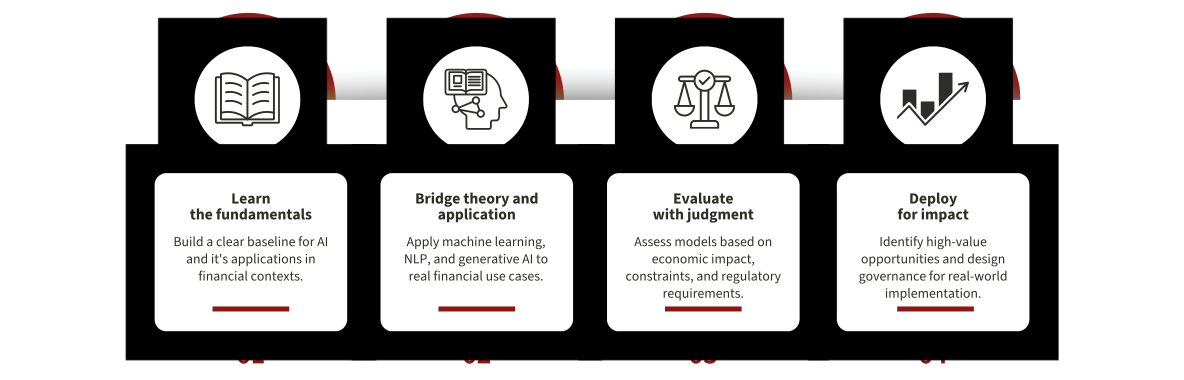
Key takeaways

Understand AI in financial contexts: Learn how ML models operate

Work with real financial data: Navigate noise, weak signals, and time variation

Extract insights from text: Use NLP for documents, disclosures, and earnings calls

Evaluate blockchain utility: Identify when blockchain adds value in finance and when it doesn’t

Manage real-world risk: Govern AI systems in regulated environments
Apply AI to real financial decisions
By the end of the course, you will be able to:
✔ Identify high-value use cases: Link AI to business problems and data
✔ Evaluate real performance: Go beyond accuracy to economic impact
✔ Design governance frameworks: Apply structured oversight and controls
✔ Bridge strategy and execution: Align business goals with data science
✔ Cut through AI hype: Evaluate real-world use cases and distinguish pilots from production-ready systems
Who is this online course for?

Finance leaders and executives responsible for evaluating AI initiatives, managing model risk, and providing governance and oversight for high-stakes financial decisions

Investment and asset management professionals interpreting AI model outputs and assessing their implications for portfolio risk, performance, and strategy

Risk, compliance, and regulatory specialists overseeing validation, explainability, and responsible AI use in regulated financial environments

Corporate finance and strategy leaders determining where AI investments align with business objectives, capital priorities, and organizational constraints

Digital transformation and analytics professionals bridging technical teams and financial decision-makers to evaluate AI use cases without requiring coding expertise
Course outline
Build a shared baseline in AI and finance to navigate the course without being hindered by vocabulary or data assumptions.
Define core AI terms and how machine learning, deep learning, and generative AI relate
Place artificial intelligence developments on a clear, historical timeline
Translate AI concepts into the realities of financial data, including weak signals and noisy outcomes
Establish a clear mental map of the course topics and learning objectives
Build a practical understanding of how machine learning works and how it is applied in financial contexts.
Understand core machine learning methods used in finance
Distinguish between prediction, classification, and pattern discovery
Evaluate model performance using real-world financial metrics
Understand trade-offs between accuracy, interpretability, and stability
Apply best practices for testing models using time-series data
Apply machine learning to real investment decisions from signal generation to portfolio performance.
Use machine learning to generate and interpret return forecasts
Translate model outputs into portfolio decisions and investment strategies
Compare machine learning approaches with classical factor investing methods
Work with alternative data such as transactions, text, and geolocation
Evaluate strategies using real-world constraints like risk, costs and stability
Turn unstructured financial text into actionable insights using modern AI tools.
Extract signals from earnings calls, filings, and news
Use generative AI to summarize, classify, and analyze documents
Build scalable workflows for document-heavy financial processes
Understand risks such as hallucinations, bias, and data leakage
Apply AI safely in regulated financial environments
Understand how blockchain works and when it actually creates value in finance.
Learn how blockchain enables shared records without centralized control
Understand core concepts such as transactions, consensus, and smart contracts
Evaluate real-world use cases across payments, insurance, and supply chains
Assess risks including custody, regulation, and market structure
Determine when blockchain adds value and when traditional systems are better
Learn how to design, evaluate and govern AI systems in regulated financial environments.
Understand how AI fits within global financial regulatory frameworks
Identify risks across model, process, and system levels
Evaluate AI systems using a structured supervisory framework
Design governance, monitoring, and control mechanisms
Build deployable AI systems that meet regulatory and ethical requirements
See how AI is actually used in finance and what separates success from failure.
Analyze real-world case studies across investing, risk, and operations
Connect model performance to economic outcomes, and business value
Evaluate strengths and limitations of real AI applications
Identify where AI creates the most value in financial services
Apply frameworks to assess new AI use cases in practice
Build practical AI judgment through hands-on application
Learners work with modern AI platforms and applied finance examples through guided, no-code exercises focused on interpretation and decision-making. The emphasis is on understanding model behavior and evaluating outcomes, not on technical implementation.
All platforms and examples are used to develop judgment and fluency, rather than focus on technical implementation.
Capstone project
The course culminates in a capstone project where you will apply the frameworks and tools learned to a specific strategic challenge from your own organization or sector. You will identify a high-value AI use case, evaluate data requirements, and design a governance plan for deployment.
Building on the financial applications explored throughout the course, you will ground your work in realistic constraints, including data quality, model performance, operational considerations, and regulatory requirements.
By the end of the project, you will have a clear, structured proposal that connects AI capabilities to financial outcomes, demonstrating how models translate into real-world decisions and measurable impact.
Frameworks, methods, and tools you will use
You will work with:
Frameworks for identifying high-value AI use cases across investing, credit, and risk
A structured supervisory framework for evaluating AI systems
Approaches to interpreting model performance using economic metrics such as Sharpe ratio and factor exposures
Methods for model validation, including out-of-sample testing and backtesting
Risk management approaches addressing bias, data leakage, and market effects
Natural language processing (NLP) workflows, including large language models (LLMs), for tasks such as earnings calls and financial disclosures
Course walkthrough

Learn from Stanford faculty
Gain insights from Stanford faculty whose research and teaching inform discussions on how AI is evaluated and applied in financial and economic settings.

Flexible, self-paced learning
Complete the course online with a manageable weekly commitment designed for working professionals.

Hands-on financial AI applications
Apply AI frameworks to real financial use cases across investment, risk, compliance, and operations.

Guided peer discussions
Engage in discussion forums with finance and business professionals from around the world.

Work with modern AI tools
Use no-code tools including AutoML, pre-trained language models, and data visualization to interpret models and outcomes.

Earn a Stanford Online Certificate of Achievement
Receive a credential that recognizes your ability to evaluate and apply AI responsibly in finance.
Featured course elements

Use structured frameworks to evaluate where AI creates value in financial decision-making and where data, risk, and regulation impose limits.

Examine how interpretability, oversight, and regulatory constraints shape the use of AI in high-stakes financial environments.

Analyze practical use cases across investment management, risk, compliance, and operations to understand how AI moves from models to measurable outcomes.
Industry insights
60%
70%
85%
Instructor

Associate Professor, Management Science and Engineering, Stanford University
Markus Pelger is an Associate Professor of Management Science and Engineering at Stanford University and a Chambers Faculty Scholar in the School of Engineering. He is also a ...

Certificate of Achievement from Stanford Online
All learners who successfully complete the course will be awarded a Stanford Online Certificate of Achievement. This certificate serves as a testament to your dedication and expertise in the subject matter. The Certificate of Achievement for an individual course will be issued in a digital badge format, allowing you to share your accomplishments with your network, verify your credentials to employers, and communicate the scope of your acquired expertise. In addition, you will earn 4 Continuing Education Units.
FAQs
Learning with Stanford Online gives you access to live faculty-led sessions, interactive exercises, and practical assignments you can apply directly to your professional context. You’ll also engage with peers from diverse industries, enhancing collaboration and perspective.
Yes. All participants who successfully complete the AI in Finance: Markets, Models and Decision-Making course will be awarded a Stanford Online Certificate of Achievement delivered in a digital badge format and verified on the blockchain, along with Continuing Education Units (CEUs). This credential recognizes proficiency in the course material. The digital badge format allows you to share your accomplishments with your network, verify your credentials to employers, and communicate the scope of your acquired expertise.
No prior programming or AI background is required. The course is designed for finance and business professionals who want to build fluency in AI concepts without coding or model development.
This course is ideal if you are responsible for financial decisions, AI initiatives, or strategic oversight and want to move beyond surface-level AI adoption. If you have questions about fit, a program advisor can help you determine whether this course aligns with your goals.
Applicable taxes will be calculated and added at checkout in accordance with country/state regulations.
Connect with a Program Advisor for a 1:1 session
Didn't find what you were looking for? Schedule a call with one of our Global Alumni Program Advisors or call us at +1 315 871 5140
Register now and boost your professional trajectory.
Starts on