

ONLINE COURSE
AI-Driven Leadership: Strategies for the Future
Lead teams, strategy, and growth in the age of AI
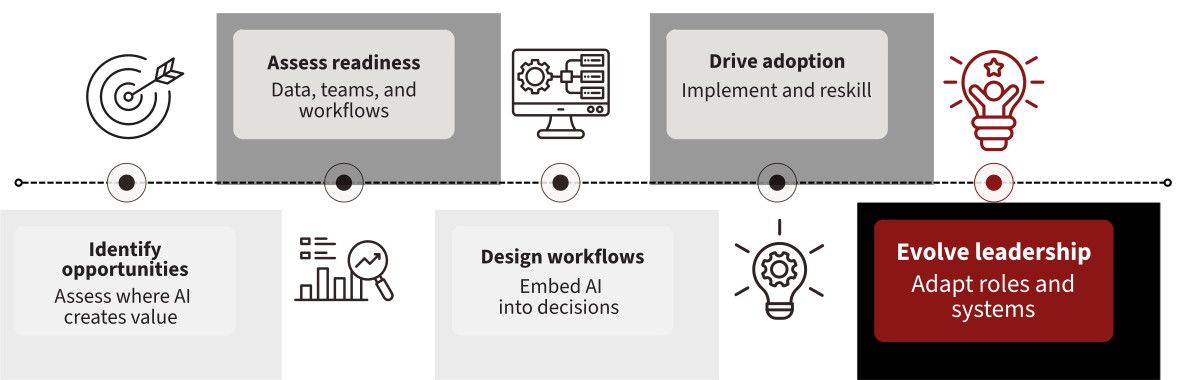
How this learning journey unfolds
Key takeaways
Identify how leaders create the conditions for effective development of generative AI, agentic AI, and predictive analytics capabilities.
Develop a plan to create those conditions, including anticipating likely barriers and strategies for success.
Assess organizational data readiness for AI and promote a culture of data excellence.
Understand how to configure workflows across these technologies, including reskilling needs and change management.
Design and implement workflows and assess their impact.
Assess the evolving role of managers and their responsibilities in the context of increasing reliance on AI technologies.
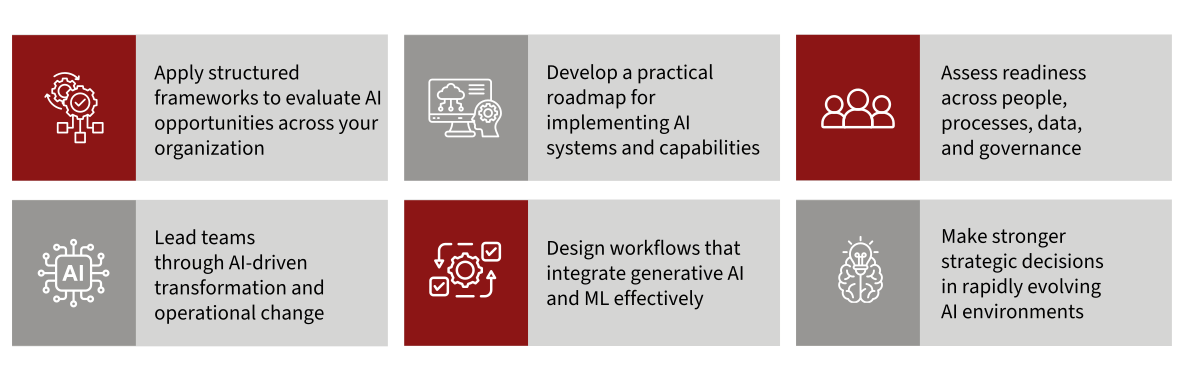
By the end of this course, you will be able to
Who is this online course for?

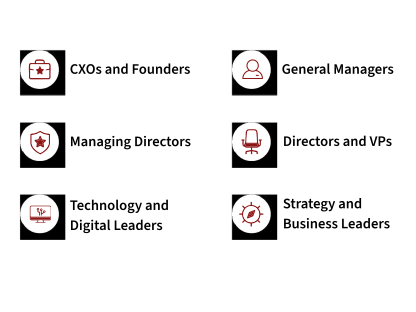
Mid- to senior-level executives including CEOs, CTOs, and leaders with decision-making authority who want to integrate artificial intelligence into their organizations

Digital transformation managers and other managers leading organizational digital initiatives who seek to adapt their leadership capabilities for the digital era

Entrepreneurs and business owners looking to implement AI strategies in their businesses

Leaders of data teams seeking to increase their impact within their organization by employing various AI tools and systems
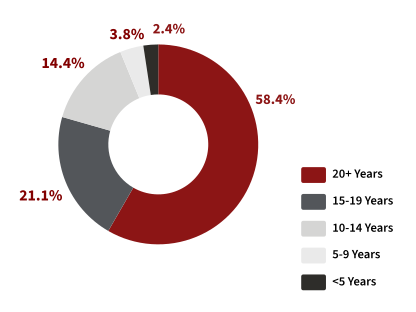
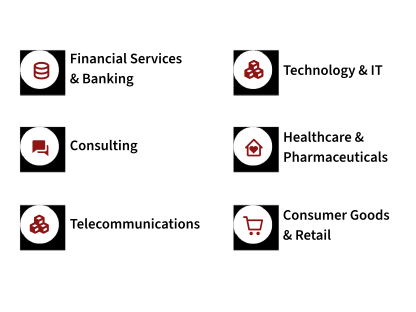
Past participant profiles
Work experience
Top industries
Top profiles
Course outline
1
How leaders create conditions for effective integration of predictive analytics
Understand the leadership actions that drive adoption and effective use of predictive analytics tools.
Illustrate leadership activities that foster effective implementation of predictive analytics tools and how they influence team members' adoption and utilization of these tools
Assess current frameworks, organizational structures, and evaluation methods for predictive analytics
Develop a new framework, propose a novel organizational structure for AI implementation, and outline innovative evaluation procedures for AI initiatives
2
How leaders create conditions for effective integration of generative AI and agentic AI
Learn how leaders guide the successful implementation of generative AI systems across teams and workflows. Learners will also explore the distinction between agentic and non-agentic systems, including their implications for governance, scaling, and organizational design.
Describe differences between predictive analytics and generative AI, including differing risks and opportunities
Summarize leaders’ activities that foster effective generative AI implementation and how they shape team members’ adoption and use of these tools
Evaluate existing framing, structuring, and evaluation schemes for generative AI
Create new framing for a generative AI strategy, draw up a new proposal for AI structuring, and define new AI evaluation processes
Understand maturity models for generative and agentic AI adoption, from experimentation to enterprise-scale systems
3
Creating a culture of data excellence
Strong AI systems require strong data foundations.
Evaluate your current organizational data culture, focusing on issues related to data quality, misuse, silos, integration, and governance
Assess organizational data readiness for generative AI
Formulate a governance, compliance, and ethical framework for sustaining high-quality, well-governed data
4
Configuring workflows and decisions for machine learning (ML)
Understand how ML changes processes, workflows, and decision-making.
Discover the different ways that ML workflows are configured
Predict when a change process or tool is likely to produce resistance or adoption
Plan or design an ML workflow
5
Configuring workflows for generative AI and agentic AI
Explore how modern AI systems can be embedded into day-to-day operations.
Understand the different ways in which generative AI workflows are configured
Recognize essential evaluation practices for generative AI workflows
Plan or design a generative AI workflow
6
How the work of managers will change in the age of AI
Examine how leadership roles evolve when AI becomes part of management systems.
Examine how managers are using AI to design organizations, focusing on AI’s role in decision-making, structuring information flows, and coordinating resources
Describe the risks and opportunities associated with algorithmic management
Conceptualize a tool to aid in an organizational or managerial function
* Familiarity with the human-centered design process is helpful.
Capstone project
In the capstone project, you will apply the core frameworks to plan the implementation of an AI capability within an organization. You will identify and prioritize high-impact use cases, assess organizational readiness, and evaluate the potential impact on workflows, teams, and business performance.
Using the leadership strategies explored throughout the course, you will examine likely barriers to adoption, define approaches for change management and reskilling, and outline the governance conditions required for successful execution. Through this capstone, you will strengthen your ability to lead AI transformation initiatives while applying practical frameworks to real-world organizational challenges.
Frameworks and methods you will use
This course equips you with practical frameworks and approaches to evaluate, apply, and lead AI adoption in organizational settings. The focus is on helping leaders make better strategic decisions in environments in which AI capabilities, workforce expectations, and competitive pressures are rapidly evolving.
You will work with:
Frameworks to assess areas in which predictive analytics, agentic AI, and generative AI can create value
Methods to identify high-impact use cases and avoid low-value initiatives
Approaches to evaluate organizational readiness across data, teams, and workflows
Decision frameworks for integrating AI into leadership and management systems
Techniques for redesigning workflows to combine human expertise with AI capabilities
Structured approaches to manage governance, adoption barriers, and change effectively
Frameworks to evaluate the maturity and scalability of generative and agentic AI systems within organizations
Course walkthrough

Live sessions with Stanford faculty

Learn with an AI Tutor for a seamless experience

Hands-on assignments to apply AI strategies and workflows

Real-world case studies on AI adoption and transformation

Practical learning to build AI-ready organizations

Certificate of Achievement from Stanford Online
Instructor

Melissa Valentine
Associate Professor of Management Science and Engineering, Stanford University
Melissa Valentine is an Associate Professor at Stanford University in the Department of Management Science and Engineering and a Senior Fellow at the Stanford Institute for Hu...

Certificate of Achievement
All learners who successfully complete the course will be awarded a Stanford Online Certificate of Achievement, recognizing proficiency in the course material.
The Certificate of Achievement for an individual course will be issued in a digital badge format, verified on the blockchain. The digital badge format allows you to share your accomplishments with your network, verify your credentials to employers, and communicate the scope of your acquired expertise.
4 CEU-equivalent.
Learner feedback
Overall, I found the course very valuable, especially in how it connected strategy, organizational change, and practical workflow transformation. The focus on augmentation, experimentation, and adoption challenges was particularly strong, and helped connect AI leadership to real business contexts. I particularly enjoyed the course structure, the frameworks leveraged, the webinars, and the office hours....
Eleonora O'Connor
Principal International Growth Consultant-EMEA Agency Partners,
Google Ireland
The course was well structured throughout the six weeks, offering deep grounding in theory as well as a clear understanding of how it can be executed in real situations. It gave me a more organized framework for implementing AI, both in a legacy organization like IBM and in shaping a new organization from first principles. Without this course, I may have taken much longer to understand how to guide AI through objective thinking, thought leadership, and disciplined execution....
Prashant Parida
Strategy & Transformation Leader,
IBM
As someone already working at the intersection of AI and organizational transformation, this program gave me the frameworks to think like an organization architect.
What stood out most was the opportunity to connect these ideas to the full process of human-AI organizational transformation: mapping where collaboration creates leverage, sequencing cultural and structural change, and thinking more intentionally about where human judgment is irreplaceable.
The final wrap-up session with Professor Valentine was the most valuable experience of the program. The quality of conversation, the connections with people in my city and industry, and the sense of being part of something were exactly what I had hoped the course would feel like throughout....
Shivani Singh
Head of Program Management,
PayPal
FAQs
1
What advantages does our online learning experience offer?
Studying online with us extends past a strictly digital learning experience. With Stanford Online, you’ll have the chance to:
Attend international workshops and live webinars.
Collaborate and engage with Stanford professors, instructors, and contributors.
Meet and network with other course participants from all over the globe.
2
Will I receive a Certificate of Achievement?
Yes. All participants who successfully complete the course will be awarded a Stanford Online Certificate of Achievement delivered in a digital badge format and verified on the blockchain, along with Continuing Education Units (CEUs). This credential recognizes proficiency in the course material. The digital badge format allows you to share your accomplishments with your network, verify your credentials to employers, and communicate the scope of your acquired expertise.
3
Are any taxes applicable to this course?
Applicable taxes will be calculated and added at checkout in accordance with country/state regulations.
Connect with a Program Advisor for a 1:1 session
Didn't find what you were looking for? Schedule a call with one of our Global Alumni Program Advisors or call us at +1 315 871 5140
Explore complementary learning experiences
AI-Driven Leadership and Product Design
Build capabilities across AI leadership and AI product design
Benefit from 15% savings on this multi-course series
Artificial intelligence is transforming how organizations make decisions and how products are designed and experienced. Effective leaders need the ability to guide AI adoption while understanding how AI systems shape user experiences and trust.
This multi-course series brings together AI-Driven Leadership: Strategies for the Future and UI/UX Design for AI Products, enabling learners to explore both strategic decision-making and AI product design principles.
This multi-course series brings together AI-Driven Leadership: Strategies for the Future and UI/UX Design for AI Products, enabling learners to explore both strategic decision-making and AI product design principles.

Register now and boost your professional trajectory.
Starts on